You Won’t Believe These Tokyo Festival Spots – Pure Magic at Every Turn
If you’ve ever dreamed of capturing Japan’s soul through your lens, Tokyo’s festival scenes are where it all comes alive. I’m talking vibrant energy, traditional costumes, and streets pulsing with rhythm. From lantern-lit alleys to drum-filled processions, each moment feels like a living postcard. As someone who’s wandered these celebrations firsthand, I can say: the city transforms in ways you never expect. This is more than sightseeing—it’s feeling the heartbeat of a culture, one frame at a time. The way light dances off gold-leafed shrines, how laughter echoes between wooden geta sandals clacking on stone, the scent of grilled mochi rising with morning mist—these are the textures of Tokyo’s festivals. They’re not staged for tourists; they’re lived, breathed, and passed down through generations. And for those who carry a camera, they offer something rare: authenticity in motion.
The Pulse of Tokyo’s Festivals: Where Tradition Meets the Lens
Tokyo’s festivals, or matsuri, are not merely annual events—they are living threads woven into the city’s cultural fabric. Each celebration carries centuries of history, from Shinto rituals honoring kami (spirits) to community-wide expressions of gratitude for harvests, safety, or seasonal change. For photographers, these moments offer a rare convergence of motion, color, and emotion. Events like the Sanja Matsuri in Asakusa or the Kanda Matsuri in Chiyoda are not performances but participatory experiences, where locals become both performers and devotees. The energy is raw and unfiltered, making every photograph a candid testament to tradition in action.
What sets these festivals apart is the balance between reverence and revelry. A mikoshi procession, for instance, is both a sacred ritual and a neighborhood celebration. Men in traditional happi coats carry the portable shrine through narrow streets, chanting and swaying with rhythmic intensity. The shrine is believed to house a deity, and its movement is said to purify the area. Yet, the atmosphere is far from somber—children wave flags, elders cheer from doorsteps, and food vendors call out to passersby. This duality creates powerful photographic opportunities: the solemn focus of a carrier’s face juxtaposed with the joyous chaos surrounding him.
For photographers, understanding the meaning behind the rituals deepens the impact of their images. It shifts the lens from mere documentation to storytelling. A shot of a priest performing a purification rite with a haraigushi (ritual wand) becomes more than a visual—it becomes a moment of spiritual continuity. Similarly, a child’s wide-eyed wonder as they watch a lion dance during a New Year festival speaks to the intergenerational transmission of culture. These are not fleeting scenes; they are echoes of a living heritage, captured in real time.
Asakusa: The Soul of Festival Photography
If Tokyo has a spiritual heart, it beats strongest in Asakusa during festival season. Centered around Senso-ji, the city’s oldest Buddhist temple, this neighborhood transforms into a stage of sensory richness when matsuri are in full swing. The iconic Kaminarimon Gate, with its giant red lantern, becomes a natural focal point for wide-angle shots, especially at dusk when the glow of paper lanterns begins to flicker to life. The approach down Nakamise-dori, lined with souvenir stalls and food vendors, offers a dynamic corridor of movement and color—ideal for capturing the rhythm of daily life intertwined with celebration.
One of the most photogenic moments occurs in the early morning hours, before the crowds arrive. Steam rises from yaki-manju stands, blurring the edges of lantern light, while temple bells echo softly in the distance. This quiet prelude contrasts sharply with the midday explosion of activity during the Sanja Matsuri, when thousands gather to witness the mikoshi parades. The shrines are carried aloft, sometimes even shaken vigorously—a practice believed to energize the deity within. From a photographic standpoint, this motion presents both a challenge and an opportunity. Using a slightly slower shutter speed can convey the dynamic energy of the carriers’ movements, turning a static image into a visual echo of sound and force.
For optimal shots, positioning is key. Elevated viewpoints, such as the second-floor walkway near the temple’s main hall, provide a broader perspective of the procession. Low-angle shots, taken from ground level, emphasize the weight and power of the mikoshi, making it appear almost mythic. Capturing the faces of onlookers—especially elderly women in kimonos or children perched on parents’ shoulders—adds emotional depth. These are not just spectators; they are inheritors of a tradition, and their expressions often tell stories no caption could fully convey.
Hidden Gems Beyond the Main Stages
While the grand processions draw the most attention, some of the most compelling photographs emerge from the quiet spaces between the spectacle. Just steps away from the main parade routes in Asakusa, narrow side streets reveal intimate moments of preparation and reflection. In small family homes, women adjust ornate hairpieces on young girls in embroidered yukata. In backroom workshops, artisans repair festival masks or paint new ones with meticulous care. These behind-the-scenes glimpses offer a different kind of authenticity—one rooted in patience, craftsmanship, and quiet devotion.
One such moment might be a grandmother helping her granddaughter tie the obi of a child’s festival kimono, their hands moving with practiced ease. Another could be a young boy holding a fox mask, peering out from beneath it with a mix of shyness and pride. These are not posed shots; they are fragments of daily life elevated by occasion. They speak to the continuity of tradition, not as a museum exhibit, but as a lived reality.
Even within the temple grounds, quieter corners offer powerful compositions. A lone elderly man praying at a side altar before the noise of the festival begins, his hands pressed together in silent devotion. A row of ema—wooden prayer plaques—hung with colorful wishes, swaying gently in the breeze. These scenes invite a slower, more contemplative approach to photography. They reward patience and observation, reminding the photographer that not every story needs movement to be meaningful.
Wandering off the main path also increases the chances of meaningful interaction. A smile shared with a vendor, a nod from an elder, a child’s wave—these small exchanges often lead to the most genuine portraits. The key is to move with respect, to linger without intruding, and to let moments unfold naturally. In these quieter spaces, the camera becomes less a tool of capture and more a bridge of connection.
Light, Color, and Motion: Mastering Festival Aesthetics
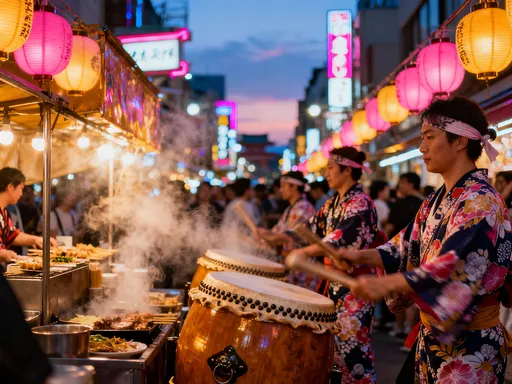
The visual language of Tokyo’s festivals is rich with contrast and texture. Neon lights from yatai (food carts) blend with the warm glow of paper lanterns, creating a palette that shifts from golden hour into night. Yukata fabrics burst with traditional ukiyo-e patterns—waves, cranes, cherry blossoms—each design carrying symbolic meaning. Even the food becomes part of the composition: skewers of glowing yakitori, pink mochi shaped like bunnies, or matcha ice cream in delicate cones. For photographers, these elements are not just background details; they are essential components of the story.
Mastering the interplay of light and motion is crucial. During taiko drum performances, for example, the drummers’ arms swing with powerful, repetitive motion. Using a shutter speed of 1/15 to 1/30 of a second can create a sense of movement while keeping the drummer’s body relatively sharp—a technique known as motion blur. This conveys the physicality of the performance, making the viewer almost hear the thunderous beats. Similarly, panning—following a moving subject with the camera—can isolate a mikoshi carrier against a blurred background, emphasizing speed and direction.
Natural framing is another powerful tool. The torii gates of shrines, the arched roofs of temple buildings, or even the bamboo poles used to hang lanterns can serve as organic borders within the frame. These elements ground the image in place and culture, adding layers of meaning. A shot of a child running through a torii gate during a festival, for instance, can symbolize passage, tradition, or innocence—depending on context and composition.
Color grading in post-processing should aim to preserve the warmth of the scene. Over-saturation can make images feel artificial, while underexposure may lose the vibrancy that defines these events. The goal is not perfection, but authenticity—the way the red of a happi coat looks under streetlight, or how the gold leaf on a shrine catches the last light of day. These are the details that make a photograph feel real, not retouched.
Seasonal Rhythms: When and Where to Be
Tokyo’s festival calendar follows the rhythm of the seasons, each period offering distinct visual and cultural opportunities. Spring brings the Hanami festivals, where families gather under cherry blossoms in Ueno Park or Chidorigafuchi. While not as processional as summer matsuri, these events are rich with quiet moments—couples sharing bento boxes, children chasing petals in the wind, or elderly couples sitting in contemplative silence beneath blooming trees. The soft pink hues and diffused light create a dreamlike atmosphere, ideal for portraits and atmospheric shots.
Summer is the peak of festival season, marked by heat, humidity, and an explosion of energy. The Sumidagawa Fireworks Festival in July is one of the most iconic events, drawing hundreds of thousands to the riverbanks. For photographers, the challenge lies in capturing the scale and brilliance of over 20,000 fireworks without losing the human element. Wide-angle lenses can encompass both the sky and the crowd’s upturned faces, while telephoto shots can isolate reactions—wide eyes, clasped hands, shared smiles. The reflection of fireworks on the river adds another dimension, doubling the visual impact.
Autumn brings cooler temperatures and festivals centered around harvest and gratitude. The Meiji Shrine Autumn Festival features traditional Noh and Kyogen theater performances, offering a more subdued but deeply cultural experience. The costumes, masks, and slow, deliberate movements provide a contrast to the high-energy summer events, inviting a more meditative approach to photography.
Winter closes the cycle with Omisoka, the New Year’s Eve celebration, when people visit temples to ring the joya no kane bell 108 times—a symbolic purification. The atmosphere is serene, even as crowds gather. The sight of steam rising from hot amazake stands, the sound of bells echoing in the cold air, and the sight of families dressed in their finest kimonos create a sense of renewal and reflection. For photographers, this is a time of quiet dignity, where every image carries a sense of hope and continuity.
Respect Through the Lens: Ethical Photography Practices
Photographing cultural events comes with a responsibility to honor the people and traditions being documented. In Tokyo’s festivals, this means understanding the unspoken rules of engagement. While many participants welcome photos, especially in public parade settings, there are moments that demand restraint. Close-up shots of individuals in prayer, children who appear uncomfortable, or rituals that are not meant for public viewing should be approached with caution—or avoided altogether.
When in doubt, the simplest rule is to observe first, shoot later. A moment of stillness often reveals whether a scene is open to documentation. If someone makes eye contact and smiles, it’s usually a sign of acceptance. If they turn away or gesture subtly, it’s best to lower the camera. In some cases, a quiet nod or a soft “sumimasen” (excuse me) before taking a portrait can go a long way in building trust.
There are also cultural nuances to consider. For example, pointing with your camera lens directly at someone’s face can be seen as intrusive. Using a wider composition that includes context—such as a person within a crowd or a ritual within its setting—can be more respectful. Additionally, photographing food offerings or sacred objects without permission may be inappropriate, as these items hold spiritual significance.
Some of the most powerful images I’ve taken were the ones I waited for—moments that unfolded naturally because I was patient, not intrusive. A grandmother adjusting her grandson’s hat before a procession. A young woman catching her breath after dancing in a parade. These were not stolen shots; they were shared moments, made possible by presence rather than pursuit. When photographers approach festivals with humility, they don’t just take pictures—they build bridges.
From Snapshots to Stories: Crafting Your Festival Narrative
A single photograph can capture a moment, but a collection of images can tell a story. The most memorable festival photography does not rely on isolated “perfect” shots but on a sequence that conveys journey, emotion, and transformation. Think of your photo set as a visual essay: it should have a beginning (arrival, anticipation), a middle (action, climax), and an end (reflection, departure).
Start with establishing shots—the temple at dawn, empty streets before the parade, a single lantern glowing in the mist. These set the stage. Then move into the heart of the action: the mikoshi being carried, the taiko drums in motion, the crowd’s energy. Include close-ups of details: a hand gripping a festival flag, sweat on a dancer’s brow, the texture of a wooden mask. Finally, end with quieter moments: an elder folding a prayer slip, a child asleep on a parent’s back, the last firework fading into the night sky. This arc mirrors the natural rhythm of the festival itself.
When editing, resist the urge to over-process. The warmth of Tokyo’s festivals lies in their authenticity, not in dramatic filters or high contrast. Aim for a consistent tone—perhaps slightly warm, with balanced shadows and highlights. If you’re sharing your work in a photo book or online gallery, consider adding brief captions that provide context without over-explaining. Let the images speak, but give them space to be understood.
Most importantly, remember that these photographs are not just souvenirs. They are invitations—to remember, to reflect, to connect. When a viewer sees your image of a child’s first festival, they may recall their own childhood traditions. When they see a couple sharing mochi under a paper lantern, they might think of love, family, or home. In this way, your photography becomes more than art; it becomes a vessel for shared humanity.
Tokyo’s festival photography isn’t about chasing perfect lighting or rare angles—it’s about connection. Each shutter click captures a fragment of tradition, a burst of joy, a whispered prayer in a crowded street. When you aim your lens with curiosity and care, you don’t just document the city—you become part of its story. So pack your camera, step into the flow, and let Tokyo’s festivals show you what it means to truly see.