Unseen Genoa: The Hidden Districts Only Locals Know
Ever wondered what lies beyond the cruise ships and postcard views of Genoa? I’m talking about the real city—narrow alleys humming with life, forgotten squares, and neighborhoods where time moves slower. This isn’t the tourist trail. These are the secret districts, tucked between hills and sea, where tradition runs deep and every corner tells a story. Let me take you where maps don’t, into the soul of a city most never truly see. Away from the polished facades and curated itineraries, Genoa reveals itself in quiet courtyards, sun-dappled piazzas, and the murmur of dialect in shadowed passageways. Here, the past isn’t preserved behind glass—it’s lived, breathed, and passed down with every warm slice of focaccia and every net mended by hand.
Beyond the Port: Discovering Genoa’s Authentic Soul
Genoa is often reduced to its historic port and Christopher Columbus’s birthplace, but its true character lives in lesser-known districts. While cruise passengers disembark into a well-trodden circuit of the Acquario and Via Garibaldi, the city’s pulse beats strongest in places like Sampierdarena, San Teodoro, and Maddalena—neighborhoods that resist simplification. These areas were shaped by centuries of maritime trade, waves of migration, and the quiet resilience of working families. Unlike the curated heritage of the Strada Nuova, these districts offer an unfiltered portrait of Ligurian life, where daily routines unfold without performance or pretense.
In the early morning light, fishermen haul in the day’s catch along the docks of Sampierdarena, while in San Teodoro, elderly residents gather on weathered benches beneath centuries-old arches. The scent of salt and frying fish lingers in the air, mingling with the earthy aroma of damp stone. These are not attractions—they are lived experiences. Families shop at open-air markets where vendors call out prices in rapid Genoese dialect, and children play in narrow courtyards that open unexpectedly between buildings. The city’s soul isn’t found in museums; it’s in the rhythm of these streets, where history isn’t displayed—it’s carried forward.
Tourists may visit the Palazzo Ducale for its grand halls and temporary exhibitions, but locals live in the spaces between. In the Maddalena district, once home to sailors and dockworkers, you’ll find restored facades standing beside buildings still marked by time and weather. This contrast isn’t decay—it’s authenticity. It tells a story of continuity, where modern life coexists with layers of the past. To understand Genoa, one must move beyond the port and embrace the complexity of its residential heart, where community, memory, and daily survival shape the urban landscape.
The Maze of Caruggi: Getting Lost on Purpose
The caruggi—the narrow, winding alleys that snake through central Genoa—are more than just a quirk of medieval urban planning. They are living corridors, arteries of culture and connection that have carried life through the city for over 800 years. In districts like Portoria and Prè, these alleys twist and turn with little regard for logic, creating a labyrinth that defies GPS and rewards intuition. To walk the caruggi is to surrender to the city’s rhythm, to let go of schedules and maps, and to allow discovery to unfold organically.
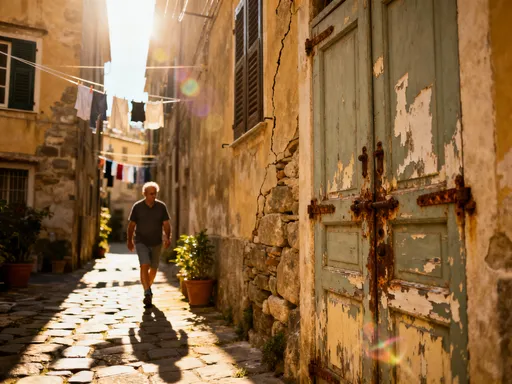
Here, sunlight filters in patches through lines of laundry strung between buildings. Cats dart between doorways, and the scent of basil, garlic, and frying olives drifts from open windows. Small bakeries tucked into corners sell focaccia di Recco—thin, cheese-filled bread pulled fresh from wood-fired ovens—while elderly neighbors exchange news in hushed tones. These alleys are not designed for tourists; they are designed for life. Locals navigate them with ease, knowing which turn leads to a hidden church, which doorway opens to a shared courtyard, and which stairway offers a sudden view of the sea.
Getting lost in the caruggi is not a mistake—it’s a method. Without the distraction of landmarks, the senses sharpen. You notice the texture of weathered stone, the sound of a distant accordion, the way ivy clings to centuries-old walls. Some alleys open into small piazzas where residents gather in the evening, sipping wine and watching children play. Others lead to forgotten chapels like Santa Maria in Passione, where silence replaces the city’s hum. This is where Genoa reveals its intimacy, not through grand gestures, but through quiet moments of connection between place and people.
Visitors are often advised to leave their phones behind when exploring the caruggi. Not only do signals fade in the stone corridors, but the act of disconnection is part of the experience. Instead of documenting every turn, one is invited to absorb the atmosphere, to move slowly, and to let the city guide them. In doing so, the caruggi become more than streets—they become a journey into the heart of Genoese identity, where history, community, and daily life converge in a tapestry of stone and sound.
Sampierdarena: Industry, Art, and Urban Revival
Sampierdarena, once the industrial backbone of Genoa, has undergone a quiet transformation. In the 19th and early 20th centuries, this district thrived on shipbuilding and manufacturing, its skyline dominated by cranes and smokestacks. Workers poured into factories at dawn, and the air buzzed with the energy of production. But as global trade shifted and industries declined, Sampierdarena faced decades of neglect. Today, however, it is emerging as a model of urban renewal—one that honors its past while embracing new possibilities.
The revival of Sampierdarena has not erased its history; it has reinterpreted it. Abandoned warehouses along the railway lines now serve as canvases for large-scale murals, part of an annual street art festival that draws artists from across Europe. The Le Cupole complex, once a disused industrial site, has been transformed into a cultural hub hosting art exhibitions, music performances, and community workshops. These spaces are not polished or commercial—they retain a raw, unfinished quality that reflects the neighborhood’s spirit.
Yet, despite these changes, Sampierdarena remains deeply rooted in its working-class identity. The fish market at Piazza della Vittoria opens before sunrise, where local vendors sell sea bream, octopus, and anchovies straight from Ligurian waters. On weekends, families gather in Piazza Colombo, children chasing each other around fountains while elders sip espresso at sidewalk tables. The district’s cafes and trattorias still serve affordable, hearty meals—pansoti in walnut sauce, trenette al pesto—prepared with recipes passed down through generations.
This balance between preservation and innovation is what makes Sampierdarena remarkable. Unlike neighborhoods that gentrify rapidly, losing their character in the process, Sampierdarena’s renewal has been community-driven. Local associations, artists, and small business owners have played a central role in shaping its evolution. Public spaces have been reclaimed not for luxury developments, but for cultural expression and neighborhood connection. As a result, the district feels alive—not as a museum of industry, but as a living testament to resilience and reinvention.
Castelletto: The Hillside Escape with a View
Perched high above the city’s bustling core, Castelletto offers a striking contrast to Genoa’s maritime intensity. This quiet residential district, accessible by foot, bus, or the iconic Lanterna elevator, provides panoramic views of red-tiled rooftops cascading toward the shimmering Ligurian Sea. From its shaded promenades and elegant 19th-century villas, one can see the entire arc of the city, from the port in the west to the hills in the east. Yet, despite its proximity to the center, Castelletto feels like a world apart—a place of calm, greenery, and unhurried living.
Locals come here to escape the noise and heat of the lower city. In the late afternoon, residents stroll along the Villetta Di Negro, a tree-lined park with benches facing the sea. Elderly couples sit together, reading newspapers or watching the sunset, while children play on the grass. Small family-run cafes serve espresso and granita, and the occasional street musician plays classical guitar beneath the plane trees. The pace is gentle, the atmosphere unhurried—a rare quality in a city known for its dense, fast-moving streets.
Castelletto’s architecture reflects its history as a retreat for Genoa’s bourgeoisie. Many of its villas were built during the 1800s, designed with ornate balconies, wrought-iron railings, and gardens that spill over stone walls. Though some have been converted into offices or cultural spaces, most remain private homes, contributing to the neighborhood’s residential charm. The streets are narrow and winding, lined with jasmine and bougainvillea, and the sound of church bells from nearby San Francesco d’Assisi drifts through the air at midday.
What makes Castelletto special is its accessibility. Unlike remote hill towns that require long drives or ferry rides, this district is just minutes from the city center. The Lanterna elevator, a historic funicular, connects it directly to Piazza delle Erbe, making it easy for residents and visitors alike to ascend for a breath of fresh air. It is not a tourist destination in the traditional sense—there are no souvenir shops or guided tours—but it is a beloved local sanctuary. For those seeking a moment of peace within the city, Castelletto offers a rare gift: beauty without spectacle, tranquility without isolation.
San Fruttuoso and Boccadasse: Coastal Gems Within the City
Just a short distance from Genoa’s urban core lie two coastal neighborhoods that feel like relics of a quieter Ligurian past. Boccadasse, with its cluster of pastel-colored houses huddled around a small pebble beach, exudes the charm of a fishing village frozen in time. Once a quiet enclave for local fishermen, it has gained popularity in recent years, drawing photographers and day-trippers eager to capture its postcard-perfect scenery. Yet, early in the morning, before the crowds arrive, Boccadasse reveals its true character—fishing boats pulled ashore, nets drying in the sun, and the smell of coffee and sea salt in the air.
A short hike or boat ride along the coast brings you to San Fruttuoso, an even more secluded destination. Nestled in a narrow cove accessible only by foot or sea, this historic site is home to a 10th-century abbey surrounded by terraced gardens and dense Mediterranean vegetation. The abbey, still maintained by a small community, stands in quiet dignity, its stone walls reflecting the colors of dawn and dusk. A bronze statue of Christ of the Abyss rests in the waters offshore, a solemn presence beneath the waves. Visitors arrive by hiking the scenic trails of Portofino Natural Park or taking a ferry from Camogli, drawn by the promise of solitude and natural beauty.
Both Boccadasse and San Fruttuoso illustrate Genoa’s dual identity—as a rugged port city and a guardian of coastal serenity. They are not theme parks or reconstructed villages; they are living places with deep roots in maritime tradition. In Boccadasse, families still gather in the evenings on the seawall, sharing wine and stories as the sun dips below the horizon. In San Fruttuoso, pilgrims and hikers find quiet reflection amid centuries of history. These neighborhoods remind us that even within a modern metropolis, pockets of stillness and authenticity endure.
For travelers, visiting these areas requires a shift in mindset. They are not attractions to be checked off a list, but spaces to be experienced with patience and respect. Arriving early, moving quietly, and engaging with local customs—such as leaving offerings at the abbey or purchasing a donation ticket—ensures that these places remain preserved not as relics, but as living parts of Genoa’s cultural fabric.
Practical Magic: How to Explore Genoa’s Hidden Districts Like a Local
Navigating Genoa’s hidden districts requires more than a map—it demands curiosity, timing, and a willingness to move at the city’s pace. The AMT public transit system, including buses and a compact metro line, provides reliable access to most neighborhoods. The metro, though short, connects Brin in the west to the city center, while buses climb steep hills to areas like Castelletto and Rivarolo. For those exploring on foot, comfortable shoes are essential; Genoa’s terrain is relentlessly hilly, and the caruggi are paved with uneven stone.
Timing matters. Early mornings are ideal for experiencing neighborhoods like Boccadasse or Prè without crowds. Markets are busiest between 8 and 10 a.m., when locals shop for fresh produce, bread, and seafood. Weekdays offer a more authentic glimpse than weekends, when tourist numbers rise. In residential areas like Sampierdarena or Castelletto, it’s wise to respect quiet hours—especially in the early afternoon, when many shops close for riposo, the traditional Italian break.
To blend in, adopt a few local habits. Order at friggitorias by pointing to what others are eating—fried olives, panelle (chickpea fritters), and cecina (a type of farinata) are staples. Use cash in small shops and family-run trattorias, as not all accept cards. Avoid loud conversations or intrusive photography, especially in narrow alleys where residents live just above street level. A simple “buongiorno” when entering a shop goes a long way.
Safety in Genoa’s lesser-known districts is generally excellent, but awareness is advised in less-trafficked areas after dark. Stick to well-lit streets, travel in pairs if possible, and avoid displaying valuables. The city is not known for crime, but like any urban area, caution is wise. Most importantly, approach these neighborhoods with humility. They are not stages for photos—they are homes. By moving slowly, listening closely, and respecting boundaries, visitors can experience Genoa not as a destination, but as a living community.
Why These Hidden Districts Matter—And How to Respect Them
As Genoa gains recognition beyond cruise itineraries, the preservation of its hidden districts becomes increasingly urgent. Places like Prè, Boccadasse, and San Fruttuoso thrive on their authenticity—the unpolished facades, the daily routines, the absence of commercialization. But growing attention threatens this delicate balance. Overtourism can erode the very qualities that make these areas special: the sense of intimacy, the local ownership, the quiet dignity of everyday life.
Mindful exploration is the answer. Travelers can support the city’s soul by choosing family-run trattorias over chain restaurants, buying from local artisans, and avoiding mass-produced souvenirs. Instead of staging photos in private courtyards or disturbing residents, visitors should observe with discretion and gratitude. A photo is fleeting; respect is lasting.
These neighborhoods are not exhibits—they are lived-in spaces where generations have raised families, run businesses, and maintained traditions. When travelers engage with them respectfully, they do more than see Genoa—they understand it. They become part of a quiet exchange, one that honors the past while supporting a sustainable future. In the end, the true magic of Genoa isn’t in its landmarks, but in its hidden corners—where the city breathes, remembers, and lives on.